
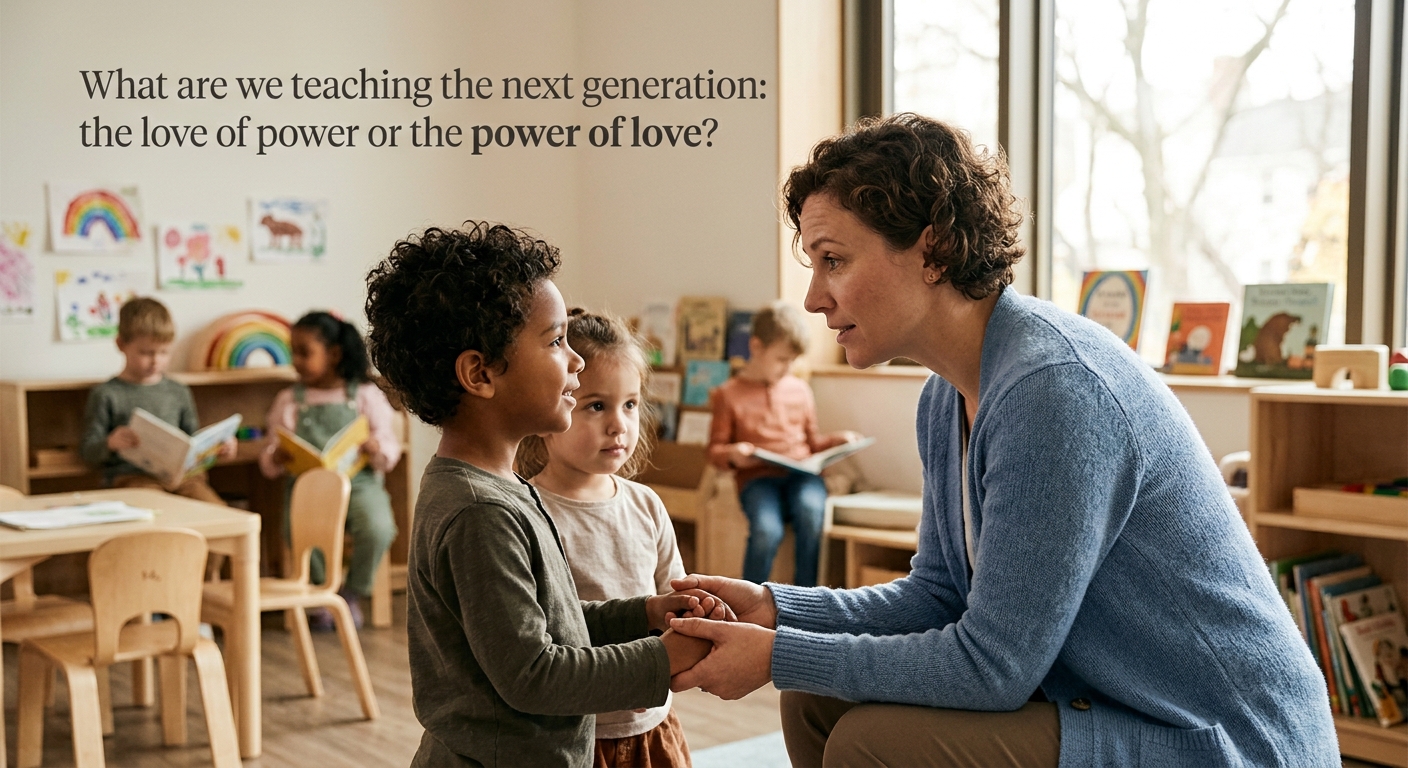

During a recent conversation with our colleagues, Dr. Sal Terrassi shared a thought that stayed with us:
“Some people in the world focus on the power of love, while others focus on the love of power.”
This simple distinction opened the door to a much deeper conversation.
What does power mean to us? Why do we seek it? How do we use the power we have? And perhaps most importantly, what do we bring into the lives of the people around us through the way we use our power?
We All Have Power
Power does not have to mean authority, status, or control.
We have the power to influence. We have the power to protect. We have the power to support. We have the power to create environments in which others feel safe, respected, and seen.
Every day, through our words, actions, choices, and even our silence, we influence the people around us.
And someone is always learning from the way we use that influence.
Children Are Watching
Our conversation naturally turned to children.
Children depend on adults for care, safety, guidance, and survival. This makes them especially vulnerable to the emotional environments created by the adults around them.
They listen to what we say, but they are also constantly observing what we do.
They notice our facial expressions, tone of voice, tension, reactions, compassion, fear, anger, and silence.
They see how we respond when something goes wrong. They observe how we treat people with whom we disagree. They notice whether we respond to difficulty with compassion or aggression, connection or control.
In this way, our way of being becomes part of what children learn about being in the world.
Our Nonverbal Messages Matter
Adults sometimes focus on finding the “right” words to say to children, especially during difficult times.
Words matter. But words are only one part of communication.
A child may hear, “Everything is okay,” while seeing fear in an adult’s face. A child may be told to remain calm while experiencing tension, anger, or panic in the environment around them.
Children are sensitive to these differences between what adults say and what adults communicate nonverbally.
During periods of prolonged stress and trauma, this becomes particularly important.
Children may be looking to the adults around them for answers to questions they cannot yet put into words:
Am I safe?
Can I trust you?
Is there hope?
What do we do when we are afraid?
How do we treat other people when life becomes difficult?
Supporting Adults Is Supporting Children
This is one of the reasons the psychological and emotional well-being of parents, caregivers, educators, psychologists, and other helping professionals matters so deeply.
Taking care of ourselves is not only personal.
Our internal state influences how we respond, connect, teach, support, and love.
This does not mean that adults must always appear calm, happy, or strong. Children can also learn from seeing adults acknowledge difficult emotions, ask for help, establish healthy boundaries, practice self-care, and find ways to reconnect with themselves and others.
When adults receive support, that support can travel much further.
It can reach a classroom.
A counseling office.
A family.
A community.
And ultimately, a child.
This is at the heart of VELA Well-being’s mission: supporting those who support others.
What Are We Teaching the Next Generation?
Perhaps the question is not whether we have power. We all do, in different ways.
The question is:
How are we using it?
Are we using our influence to control or to empower?
To divide or to connect?
To create fear or to create safety?
Are we demonstrating the love of power, or are we showing children the power of love?
Children may not remember every word we say.
But they are learning from how we live.
So today, perhaps we can each ask ourselves:
What kind of power am I bringing into the world?
What are the children around me learning from the way I use it?
And:
What do I want to bring into the lives of others today?
At VELA Well-being, we choose the power of love.
VELA Well-being — Supporting those who support others.