

How to Make a Zine: A Simple Step-by-Step Creative Exercise
One sheet of paper. A few simple materials. Endless possibilities for creativity, self-expression, and connection.
Have you ever wanted to tell a story, share something important, or preserve a meaningful memory but didn’t know where to begin?
What if all you needed was a single sheet of paper?
A zine (pronounced zeen) is a small, self-created booklet that can contain stories, drawings, photographs, memories, poetry, helpful information, or anything else you wish to express.
You don’t need to be an artist, writer, or designer to create one.
You simply need something you would like to give a page to.
At VELA Well-being, we explored zine-making during our seminar “Reflections on Identity: Working Towards Community Based Resilience,” presented by Dr. Joe Mageary.
Dr. Mageary introduced zines as an art therapy-inspired creative exercise that can encourage emotional expression, support reflection and healing, explore personal identity, and strengthen community connections.
Today, we invite you to try it yourself!
What You’ll Need
For a simple, no-staple zine, gather:
- One sheet of paper (regular printer paper works perfectly)
- Scissors
- A pencil or pen
- Colored pencils, markers, or crayons (optional)
- Old magazines, photographs, or other collage materials (optional)
- Glue or tape (optional)
That’s it!
You can create a small booklet using only paper, scissors, and a pen.
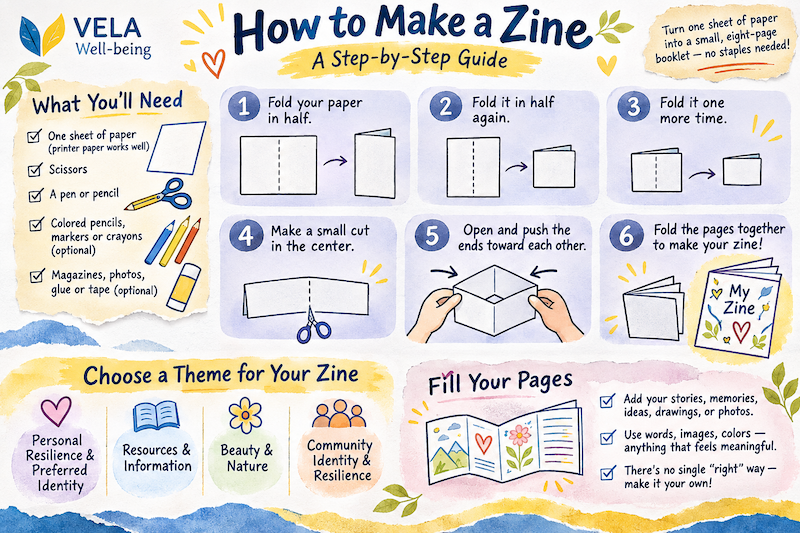
Part 1: Make Your No-Staple Zine
This technique transforms one sheet of paper into a small eight-page booklet without staples, glue, or binding.
Step 1: Fold Your Paper in Half
Take a regular sheet of paper and fold it in half, bringing the two short edges together.
Press along the fold to make a clear crease.
Step 2: Fold It in Half Again
Keep the paper folded and fold it in half again.
Press firmly along the new crease.
Step 3: Fold It One More Time
Fold the paper in half a third time.
When you unfold it completely, you should see eight equal rectangular sections.
These sections will become the pages of your zine.
Step 4: Make a Small Cut in the Center
Fold the paper in half along its long edge, creating a long, narrow rectangle.
Find the midpoint of the folded edge.
Using scissors, cut along the center crease from that midpoint to the next fold intersection, stopping halfway along the folded rectangle.
When you unfold the paper completely, there should be a short slit in the center of the sheet.
For children or group activities, an adult should assist with scissors when appropriate.
Step 5: Bring the Pages Together
Fold the sheet lengthwise again so it forms a long, narrow rectangle.
Hold the two short ends and gently push them toward each other.
The center slit will open into a diamond shape.
Continue pushing until the sections come together to form four leaves.
Fold these leaves around one another to create your booklet.
Step 6: Your Zine Is Ready!
You now have a small booklet with eight pages, including the front and back covers.
No staples required!
You can leave it blank and fill it later, or begin creating immediately.
Helpful tip: If the folding feels confusing, that’s completely normal. Try again with another sheet of paper. The first booklet can simply be your practice zine.
For an illustrated folding guide, see the tutorial referenced in Dr. Mageary’s presentation:
Part 2: Decide What Your Zine Will Be About
Now comes the most meaningful part.
What would you like to give a page to?
Your zine can be about almost anything.
During our VELA seminar, we introduced four themes for exploring identity, sharing resources, noticing beauty, and building community resilience.
1. Personal Resilience & Preferred Identity
Create a zine about who you are, what matters to you, and what helps you continue during difficult times.
You might include:
- Your strengths and values
- Important memories
- People who inspire you
- Personal accomplishments
- Things that bring you hope
- Qualities you want to preserve
Reflection: What part of yourself would you like to remember or celebrate?
2. Resources & Information
Create a zine that shares something useful with others.
You might include:
- Coping strategies
- Helpful books or websites
- Community resources
- Self-care practices
- Ideas for parents, educators, or caregivers
- Lessons learned from personal or professional experience
Reflection: What do you know that could help someone else?
3. Beauty & Nature
Create a zine about the beauty you notice around you.
Include photographs, drawings, descriptions, or memories of:
- Flowers and trees
- Sunsets and changing seasons
- Animals and birds
- Places that bring you peace
- Small everyday moments of beauty
Reflection: What made you stop, notice, and appreciate something today?
4. Community Identity & Resilience
Create a zine that celebrates a community you belong to.
It might be your family, classroom, workplace, neighborhood, cultural group, or support community.
Include:
- Shared traditions
- Important memories
- Community values
- Stories of cooperation
- Symbols of belonging
- What helps your community remain connected
Reflection: What makes your community special, and what stories deserve to be remembered?
Part 3: Fill Your Pages
Once you have chosen your theme, begin filling your booklet.
You can use words, images, colors, drawings, quotations, or anything meaningful to you.
Here is one possible way to organize your eight pages:
| Page | What to Include |
|---|---|
| 1 | Title and cover illustration |
| 2 | Why this topic matters to you |
| 3 | A meaningful story or memory |
| 4 | A drawing, photograph, or symbol |
| 5 | Something you have learned |
| 6 | Something you value or want to preserve |
| 7 | A message to yourself or others |
| 8 | A closing thought, question, or invitation |
This is only a suggestion.
Your zine does not have to follow any particular structure.
You might use all eight pages for drawings or write only a few words.
The important thing is that your creation reflects something meaningful to you.
Part 4: Remember the Sandbox Approach
One of the most encouraging ideas from Dr. Mageary’s workshop was to approach zine-making like children playing in a sandbox.
Children build sandcastles.
Sometimes they change them.
Sometimes they knock them down and begin again.
They explore without worrying whether their creation is perfect.
We invite you to bring that same attitude to zine-making.
There are no grades.
There is no competition.
There is no requirement to produce something beautiful.
If you make a mistake, you can incorporate it into your design.
If you change your mind, you can begin again.
The process of creating is as important as the finished booklet.
Give yourself permission to experiment, play, and enjoy.
Part 5: Create Alone or Together
Zine-making can be a personal reflective exercise, but it can also become a meaningful group activity.
For Individuals
Create a zine for yourself.
You might use it to explore your identity, reflect on a difficult experience, remember something important, or simply enjoy being creative.
You do not have to share it with anyone.
For Families
Invite family members to create zines about their favorite memories, family traditions, or things they appreciate about one another.
You can create individual booklets or work together on one family zine.
For Educators
Invite students to explore identity, creativity, community, and belonging through zine-making.
Allow students to choose what they want to express and how they wish to express it.
For Psychologists, Counselors, and Helping Professionals
Zines can be offered as an optional creative reflection activity to help participants explore personal strengths, values, experiences, and resources.
When working with people affected by trauma, emphasize choice, emotional safety, and the right not to share personal experiences.
The goal is not to pressure someone to disclose difficult memories. It is to offer a creative opportunity for expression.
For Community Groups
Invite members to create zines about what connects them.
You might gather individual zines into a small community collection or create one collaborative booklet.
Such collections can help preserve shared experiences and make different voices visible.
Part 6: Decide Whether to Share Your Zine
When your zine is finished, pause and ask yourself:
Who would I like to see this?
Perhaps you created it only for yourself.
Perhaps you want to share it with a friend, family member, colleague, or community.
Perhaps you would like to photograph it, make copies, or create a small collection of zines.
All these choices are valid.
Sharing is an invitation, not an obligation.
Sometimes creating something privately is enough.
At other times, sharing a story can help someone else feel seen, understood, or connected.
Why This Simple Exercise Matters
A zine is more than a folded piece of paper.
It is an opportunity to make something meaningful visible.
When we create a zine, we make choices.
We decide what matters.
We select the words, images, and memories we want to include.
We determine how our story will be represented.
For people living through prolonged stress or uncertainty, this small act of creation may offer a meaningful opportunity to exercise choice, reconnect with personal values, and express experiences that are sometimes difficult to put into words.
For communities, zines can preserve memories, share knowledge, and create opportunities to recognize one another’s experiences.
This is why we introduced zine-making during our VELA seminar on identity and community resilience.
We believe that every person has a story worth acknowledging and every community has experiences worth preserving.
Your Invitation: Start With One Page
You do not have to create something extraordinary.
You do not need expensive materials.
You do not need special skills.
Start with one sheet of paper.
Choose something meaningful.
Fold it.
Fill it.
And see what happens.
You may discover that a small booklet can hold a surprisingly important part of your story.
What would you give a page to?
Acknowledgment
This article was developed from the presentation and discussion led by Dr. Joe Mageary during VELA Well-being’s seminar “Reflections on Identity: Working Towards Community Based Resilience.”
We are grateful to Dr. Mageary for sharing zine-making as a creative, art therapy-inspired practice for exploring identity, supporting reflection and emotional expression, and strengthening community connections.
The step-by-step no-staple zine activity was adapted from the instructional resources presented during the seminar.
Suggested Tags
#ZineMaking #CreativeExpression #ArtTherapyInspired #PersonalResilience #CommunityResilience #Identity #SelfCare #VELAWellbeing