
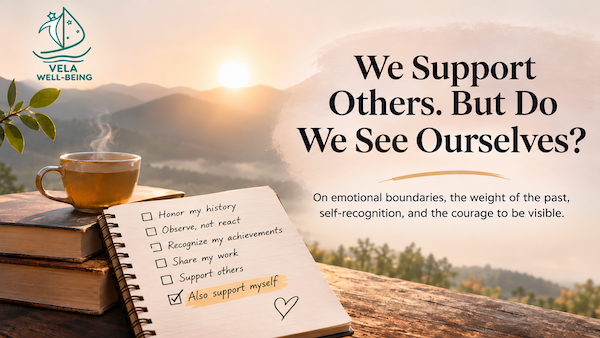

On emotional boundaries, the weight of the past, self-recognition, and the courage to be visible.
People in helping professions spend much of their lives paying attention to others.
We notice their struggles. We recognize their strengths. We encourage them to acknowledge their accomplishments, discover their potential, and move forward.
But how often do we offer ourselves the same attention?
During a recent professional peer-support discussion, several important questions emerged about memory, identity, emotional reactions, and recognizing one’s own achievements.
Although these topics may seem different, they share an important connection: How do we remain aware of ourselves while navigating the expectations, experiences, and needs of others?
1. We Can Honor the Past Without Carrying All Its Weight
Our personal and collective histories influence who we are.
We inherit stories of courage, survival, suffering, sacrifice, and resilience. Some of these stories give us strength and a sense of belonging. Others carry pain that has been passed from one generation to another.
An important question arises:
Do we need to carry everything that previous generations experienced?
Remembering difficult history does not necessarily mean living in fear of its repetition.
At the same time, forgetting or silencing painful experiences is not always the answer. Experiences that remain unspoken can continue to influence individuals, families, and communities.
Perhaps the challenge is not to choose between remembering and forgetting, but to develop a more conscious relationship with the past.
We can acknowledge suffering without making suffering the center of our identity.
We can honor survival while choosing to build a life focused on growth, creativity, connection, and well-being.
For helping professionals, this distinction is especially important when working with individuals and families affected by trauma.
Our role is not to decide which memories others should carry, but to support their ability to explore what those memories mean and how they wish to relate to them.
We can ask:
- What from my past gives me strength?
- What experiences deserve acknowledgment but no longer need to guide my everyday decisions?
- What values and lessons do I want to pass on?
- What would I like to create beyond the experiences I inherited?
We cannot change history, but we can explore how we live with it.
2. Not Every Reaction Requires Our Participation
Another important theme concerns how we respond when others criticize, misunderstand, or judge us.
Imagine sharing something simple online and unexpectedly receiving hundreds of comments.
Some are supportive. Others are critical. Some assign intentions or meanings that were never part of the original message.
It can be tempting to explain ourselves, defend our choices, or convince strangers that their interpretations are incorrect.
But there is another possibility.
We can observe what is happening without becoming emotionally involved in every reaction.
This does not mean denying our feelings or pretending that criticism never hurts.
It means recognizing the difference between an event and the meaning we assign to it.
Someone else’s interpretation of our actions does not automatically become our truth.
In the discussion, an important observation emerged: Sometimes people respond not only to what we say or do, but also to the fears, experiences, expectations, and beliefs they bring into the situation.
Recognizing this can help us create emotional distance.
Instead of immediately reacting, we might ask:
What actually happened?
What am I feeling?
Which part of this situation belongs to me, and which part belongs to someone else’s interpretation?
Does this require my attention, or can I allow it to pass?
For helping professionals, who frequently encounter strong emotions and differing perspectives, the ability to observe without automatically reacting can be an important part of maintaining emotional boundaries.
Not every comment deserves an answer.
Not every disagreement requires a defense.
And not every opinion needs to become part of our personal story.
3. Why Is It Easier to Recognize Other People’s Achievements Than Our Own?
Many helping professionals are extraordinarily skilled at seeing the potential in others.
We celebrate our clients’ progress, our students’ development, our colleagues’ successes, and the accomplishments of those we support.
But when someone asks what we have achieved, we may respond:
“It was nothing special.”
“I was just doing my job.”
“Other people did much more.”
Or simply:
“I don’t really think about it.”
Sometimes we accomplish something meaningful and immediately move on to the next responsibility.
A completed project becomes another task crossed off a list.
A successful intervention becomes part of the ordinary working day.
An initiative that benefits an entire community becomes something we barely mention.
But just because an accomplishment becomes familiar does not mean it loses its value.
There is an important difference between being humble and being unable to recognize our own contributions.
Acknowledging our achievements does not require us to compare ourselves with others or seek admiration.
It simply means being willing to see what we have done.
We may need to practice saying:
“I worked hard on this.”
“This was meaningful.”
“I contributed something valuable.”
“I am proud of what I accomplished.”
For professionals who devote themselves to others, such acknowledgment can be an important act of self-care.
4. Supporting Others Does Not Mean Remaining Invisible
Another question emerged from the discussion:
Why do we sometimes feel comfortable promoting other people’s work but hesitate to share our own?
Many professionals dedicate considerable energy to helping their colleagues, organizations, clients, and communities become more visible.
Yet they may struggle to speak about their own knowledge, expertise, or contributions.
There are many possible reasons.
Some people value privacy. Others dislike public attention. Some have experienced criticism or worry that sharing their achievements might appear arrogant.
And some simply prefer working behind the scenes.
All of these preferences deserve respect.
But it may also be worth considering whether remaining invisible is always a conscious choice.
Sometimes our experience could benefit someone who has never met us.
A practical strategy we developed might help another educator.
A successful community initiative might inspire someone to create a similar program.
A lesson learned through years of professional practice might offer encouragement to someone just beginning.
Sharing our work is not necessarily self-promotion. It can also be a way of sharing knowledge, creating connections, and expanding the impact of what we do.
We do not have to become public figures to make our work visible.
We can begin by acknowledging our contributions in ways that feel meaningful, comfortable, and consistent with our values.
5. Take Time to Recognize Your Own Success
One particularly meaningful question from the discussion was whether we allow ourselves to experience our accomplishments.
Sometimes something wonderful happens, but we are already thinking about what comes next.
We may intellectually understand that we have achieved something important without allowing ourselves to feel satisfaction, gratitude, or pride.
Consider taking a short pause after completing something meaningful.
Sit comfortably.
Take a few slow breaths.
Recall something you accomplished recently. It does not need to be extraordinary.
Perhaps you helped someone feel heard.
Perhaps you completed a difficult task.
Perhaps you maintained a healthy boundary, asked for help, or simply managed to get through a challenging day.
Notice what happens when you give that experience your attention.
Can you acknowledge the effort it required?
Can you recognize your contribution?
Can you allow yourself a moment of satisfaction?
You do not have to force any particular emotion.
Simply creating space to recognize what happened may help you develop a more compassionate relationship with yourself.
Sometimes we need to stop long enough to notice that we are doing better than we give ourselves credit for.
6. The Value of Supportive Professional Conversations
One of the important benefits of professional peer-support groups is the opportunity to hear perspectives we might not consider on our own.
Sometimes a colleague asks a question that helps us recognize an assumption.
Sometimes another person’s experience reminds us of something we have forgotten about ourselves.
Sometimes a discussion challenges us to reconsider what success, visibility, responsibility, or well-being means.
These conversations can be valuable, but they also require sensitivity.
Not everyone is ready to explore a particular subject at the same moment.
Not everyone wants to become more visible.
And not every question needs an immediate answer.
Meaningful support includes respecting another person’s boundaries, pace, and freedom to choose.
The purpose of professional dialogue is not to pressure someone into change.
It is to create opportunities for reflection, understanding, and choice.
We can encourage one another while recognizing that each person remains the author of their own decisions.
A Final Reflection: What About You?
If you work in a helping profession, consider how much attention you give to the growth, achievements, and well-being of others.
Now consider how often you give that same attention to yourself.
You may be carrying experiences that no longer need to define your future.
You may be responding to expectations that do not reflect your values.
You may be overlooking achievements because they have become part of your everyday life.
Or you may be doing meaningful work that deserves to be shared with others.
You do not need to change everything.
Perhaps you can begin with a few simple questions:
What am I carrying that I no longer need to carry in the same way?
What reactions can I observe without making them my own?
What have I accomplished that I have not yet acknowledged?
How can I support others without forgetting to recognize myself?
At VELA Well-being, we believe that supporting those who support others includes creating opportunities for helping professionals to recognize not only the needs and potential of others, but also their own.
Because those who dedicate their lives to helping others deserve to be seen, supported, and appreciated, too.
And sometimes, the person who most needs our acknowledgment is ourselves.
This article was inspired by themes explored during a VELA Well-being professional peer-support discussion. Personal details have been omitted to protect participants’ privacy.