

A Mindful Self-Check Exercise for Helping Professionals
Exercise by Dr. Marina Livshits. Expanded by Dr. Natalya Rakevich.
Duration: 5–7 minutes
Purpose: To help participants recognize their current level of emotional, physical, and mental resources without judgment, pressure, or an immediate need to change anything.
Guided Exercise: What Is in My Bag?
Sit comfortably with your back upright but relaxed. Feel your feet resting on the floor. Allow your shoulders to soften and your hands to rest comfortably.
If you feel comfortable, gently close your eyes, or simply lower your gaze.
Take a slow, gentle breath in.
And slowly breathe out.
Take another breath, noticing how you feel in this moment.
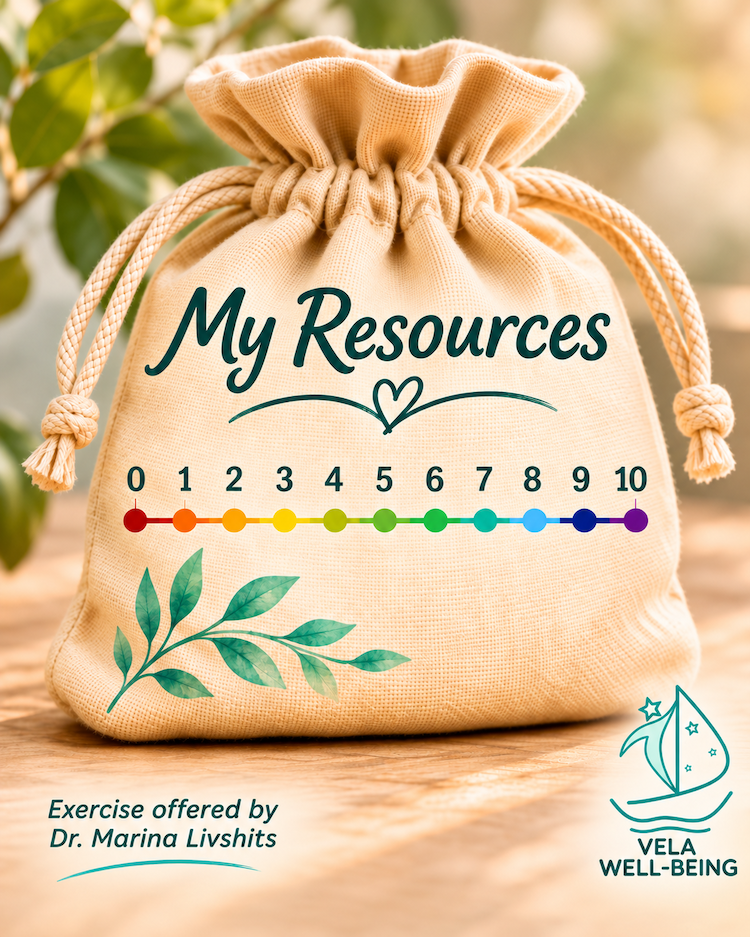
Now imagine that you have a small bag.
This is your personal bag of resources.
Inside this bag are all the resources you use every day: your energy, patience, compassion, knowledge, experience, strength, hope, and ability to care for others.
Imagine a time when you felt full of energy, motivated, inspired, and ready to help everyone.
What did your bag look like then?
Perhaps it was full, almost overflowing with resources.
Now think about your everyday life as a helping professional.
Every conversation, every challenge, every person who needs your attention may require something from this bag.
Sometimes you have opportunities to refill it.
Other times, especially during periods of prolonged stress, you may continue giving even when there is very little left.
Imagine looking into your bag right now.
How full is it today?
There is a measurement scale on your bag, from 0 to 10.
- 0 means your bag feels completely empty. You have very little energy or capacity left to give.
- 5 means your bag is about half full. You have some resources available, but they are limited.
- 10 means your bag feels completely full. You feel energized, supported, and ready to respond to challenges.
Take a moment to observe your bag.
Where are you on this scale right now?
There is no right or wrong number.
You do not have to explain it, justify it, or compare it with anyone else’s.
Perhaps yesterday your bag was at 8, and today it is at 3.
Perhaps you expected it to be full, but now realize how much you have been giving.
Whatever number comes to mind, simply acknowledge it.
Silently tell yourself:
“This is where I am right now.”
“I can acknowledge my resources without judging myself.”
“My worth is not measured by how much I can give.”
Take one more gentle breath in.
And slowly breathe out.
When you feel ready, bring your attention back to the room.
Reflection and Group Sharing
Invite participants to share only what feels comfortable.
- What number did you notice on your resource scale today?
- Was that number what you expected, or did it surprise you?
- What tends to empty your bag? What helps refill it?
- What might your bag need from you today?
Participants may choose to share just their number, a few words, or simply listen.
Facilitator’s Closing Reflection
As helping professionals, we often focus on the needs of others. We notice their pain, their struggles, and their need for support.
But how often do we pause to notice our own resources?
We cannot always control how much is asked of us, but we can practice recognizing what we have available.
Today’s exercise is not about forcing ourselves to refill the bag or expecting it to remain full.
It is about awareness.
Sometimes simply acknowledging, “My bag is almost empty today,” is an important act of self-care.
You do not need to have a full bag to be a valuable person. And you deserve care and support, too.
Facilitator’s note: Emphasize that this is a personal, subjective self-check, not a psychological assessment. Participants should never be pressured to disclose their scores. The number reflects their experience in this moment, not their professional competence, value, or ability to care for others.