
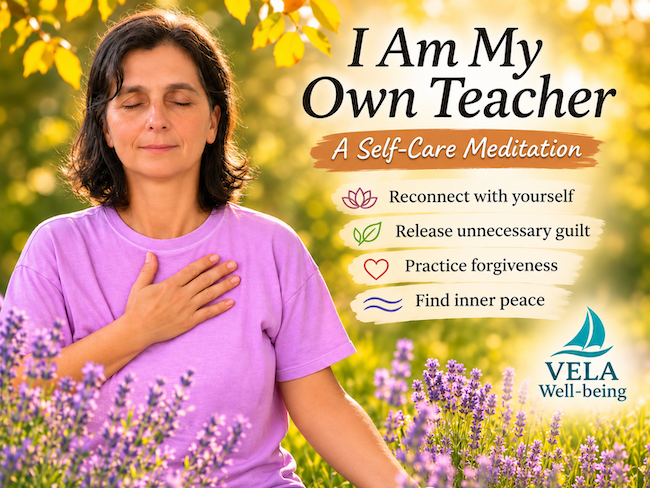

Reconnect with your inner wisdom, release self-blame, and offer yourself compassion.
Category: Mindfulness and Self-Care Exercises
Duration: 10–15 minutes
Suitable for: Helping professionals, educators, caregivers, and anyone seeking a moment of self-connection.
Why This Exercise Matters
People in helping professions spend much of their time listening to others, supporting their needs, solving problems, and offering guidance.
But how often do we offer ourselves the same attention, understanding, and forgiveness?
We may become accustomed to looking outside ourselves for answers, reassurance, or permission to rest. We may also carry guilt about things we could not accomplish, situations we could not change, or people we could not help.
This meditation invites us to turn our attention inward.
Inspired by the meditative traditions of Sahaja Yoga (Free Meditation Best Meditation Resources, n.d.), the exercise uses gentle touch, breathing, reflection, and affirmations to reconnect with our inner wisdom and practice self-forgiveness.
The central message is simple:
I am more than my thoughts, my emotions, my mistakes, or my struggles. I can listen to myself, learn from myself, and treat myself with compassion.
Step-by-Step Practice
Step 1. Create a Space for Yourself
Find a comfortable place to sit.
You may sit on a chair, on a cushion, or on the floor. Allow your back to be comfortably upright without unnecessary tension.
Place your left hand on your lap, palm facing upward.
Gently place your right hand over the center of your chest, near your heart.
If comfortable, close your eyes. Otherwise, soften your gaze.
Take a gentle breath in.
Slowly exhale.
Imagine that, for a few moments, you are closing the doors to the outside world and opening the doors to your inner world.
Notice your breathing.
Notice your heartbeat, if you can feel it.
Notice that you are here.
You do not need to accomplish anything.
For now, simply allow yourself to be.
Step 2. Recognize Your Inner Self
Keep your right hand over your heart.
In Sahaja Yoga, this part of the meditation emphasizes the pure spirit—an understanding of one’s inner essence beyond everyday thoughts and emotions.
Silently ask yourself:
- Who am I beyond my responsibilities?
- Who am I beyond my thoughts and emotions?
- Can I recognize something within myself that remains worthy of love and respect, even during difficult moments?
Pause and breathe.
Now gently repeat:
“I am not my thoughts.”
“I am not my worries.”
“I am not my emotions.”
“I am more than what I am experiencing right now.”
Allow yourself to observe whatever comes up without trying to change it.
Step 3. Connect With Your Inner Teacher
Move your right hand to your upper abdomen, just below your ribs.
In Sahaja Yoga, this area is associated with the qualities of inner guidance, mastery, and personal wisdom.
Take a breath.
Silently ask:
“Can I be my own teacher?”
Repeat the question three times, allowing a pause between repetitions.
Think about the knowledge you have gained through your experiences.
Consider the difficult situations you have already navigated.
Remember what you have learned from both your successes and your mistakes.
Now repeat slowly:
“I am my own teacher.”
“I can listen to my inner wisdom.”
“I can learn from my experiences.”
“I can ask for help without giving up trust in myself.”
Notice how these words feel.
You do not have to believe every affirmation immediately. Simply observe your response.
Step 4. Open Yourself to Understanding
Move your right hand to your lower abdomen.
In the original Sahaja Yoga meditation, this position is associated with seeking pure knowledge.
Take a gentle breath.
Silently repeat:
“Let me understand.”
“Let me listen.”
“Let me see clearly.”
Allow yourself to become curious rather than judgmental.
You might ask:
“What am I experiencing right now?”
“What might I need?”
“What have I not yet allowed myself to notice?”
You do not have to find an answer.
Sometimes awareness begins by simply allowing a question to exist.
Step 5. Release Self-Blame
Move your right hand to your left shoulder or the left side of your neck.
Gently turn your head toward the right, only as far as feels comfortable.
In the meditation practiced during the VELA session, this position was associated with releasing guilt.
Think about how often you blame yourself.
Perhaps you believe you should have done more.
Perhaps you feel guilty for resting while others are struggling.
Perhaps you criticize yourself for becoming tired, frustrated, or overwhelmed.
Take a breath.
Slowly repeat:
“I release unnecessary guilt.”
“I allow myself to be human.”
“I do not have to carry responsibility for everything.”
In the traditional meditation, the affirmation is:
“I am not guilty.”
You may repeat this affirmation if it feels meaningful to you.
Notice the difference between accepting responsibility for your actions and carrying unnecessary blame.
You can acknowledge mistakes, make amends when necessary, and still treat yourself with kindness.
Step 6. Practice Forgiveness
Bring your head back to the center.
Place your right palm gently against your forehead.
Take a breath.
Silently repeat:
“I forgive.”
“I let go.”
“I allow myself to release what I am ready to release.”
Notice any emotions that arise.
Forgiveness does not mean approving harmful behavior, forgetting what happened, or abandoning healthy boundaries.
You do not need to force forgiveness.
Now move your right hand to the back of your head.
This part of the meditation focuses on self-forgiveness.
Slowly repeat:
“I forgive myself.”
“I forgive myself for what I did not know.”
“I forgive myself for what I could not do.”
“I forgive myself for not being able to forgive everything right now.”
Pause.
Allow that last statement to settle.
You do not have to become perfectly compassionate, peaceful, or forgiving during this exercise.
Even the inability to forgive can be met with understanding.
Take another gentle breath.
Step 7. Experience the Present Moment
Move your right hand to the crown of your head.
Gently rest your palm there for a moment, then lift it slightly above your head.
In the Sahaja Yoga tradition, this gesture symbolizes connection with the deeper self and the wider universe.
Notice any sensations in your hand.
Perhaps you feel warmth, coolness, tingling, or nothing at all.
There is no correct sensation to experience.
You do not need to feel anything special for the exercise to be meaningful.
Allow yourself to be present.
Silently repeat:
“I am here.”
“I am alive.”
“I am allowed to experience this moment.”
“I am enough in this moment.”
Rest in silence for several breaths.
Step 8. Close With Compassion
Bring your palms together in front of your chest.
Gently rub your palms together until they feel warm.
If comfortable, place them lightly over your closed eyes without pressing on your eyeballs.
Take a breath.
Release your hands.
Open your eyes slowly.
Look at your palms.
Consider everything these hands have done.
The people they have helped.
The work they have accomplished.
The moments of kindness they have offered.
Now gently wrap your arms around yourself.
Give yourself a comfortable hug.
Silently say:
“Thank you for everything you do.”
“Thank you for continuing, even when it is difficult.”
“You deserve care, too.”
Reflection Questions
After completing the exercise, take a moment to reflect:
- Which affirmation was easiest for me to accept? Which was most difficult?
- What responsibilities or feelings of guilt might I be carrying unnecessarily?
- How do I respond to myself when I make mistakes?
- What might change if I trusted my own wisdom a little more?
- What is one small act of compassion I can offer myself today?
You may write down your reflections or simply observe them.
A Reminder for Helping Professionals
You can be knowledgeable and still need guidance.
You can be compassionate toward others and still struggle to offer compassion to yourself.
You can be experienced and still make mistakes.
Being your own teacher does not mean you must solve every problem alone.
It means recognizing that your experiences, emotions, observations, and inner wisdom also deserve your attention.
You can support others without abandoning yourself.
Self-care begins with recognizing that your own well-being matters.
And sometimes the most important words we can offer ourselves are:
“I forgive myself, even when I cannot forgive everything right now.”
About This Exercise
This exercise was adapted from a guided Sahaja Yoga-inspired meditation facilitated by Dr. Natalya Rakevich during VELA Well-being’s Hour of Self-Care session on November 10, 2026.
The original meditation draws on Sahaja Yoga concepts, including Kundalini, inner wisdom, the pure spirit, forgiveness, and self-realization. The practice presented here has been adapted into accessible language for a broader audience of helping professionals, while preserving its emphasis on self-awareness, compassion, and inner peace.
The exercise is intended for personal reflection and general well-being. Participants may keep their eyes open, skip any gesture or affirmation, and stop if they experience discomfort. It is not a substitute for professional mental health care.
VELA Well-being — Supporting Those Who Support Others.
Reference:
Free Meditation Best Meditation Resources. (n.d.) How to meditate? https://www.freemeditation.com/meditation-basics/how-to-meditate/