
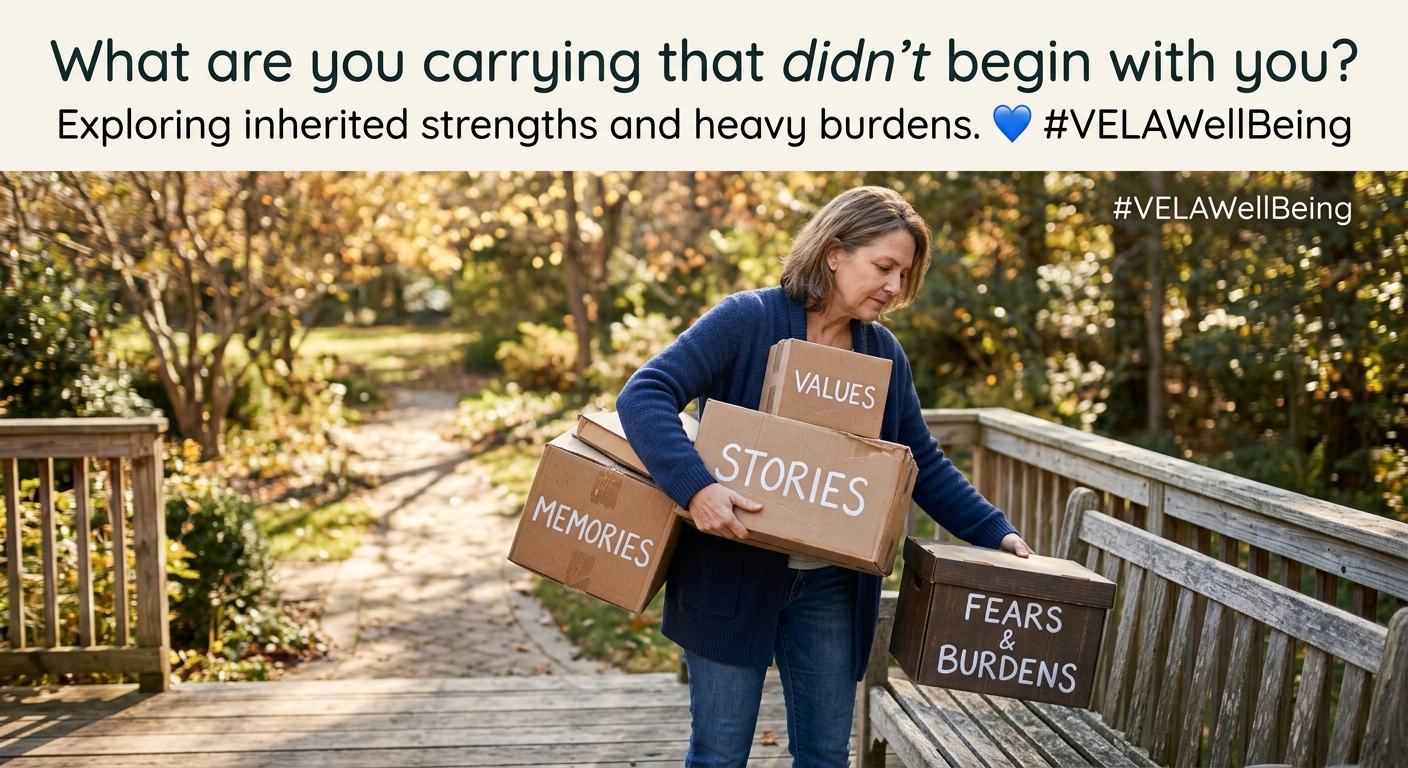

Not everything we carry started with us.
During a recent VELA Well-being case study and peer-support conversation, our discussion turned to identity, memory, family history, and the experiences we inherit from those who came before us.
One metaphor from the conversation stayed with us.
Imagine that someone you love hands you several packages. One is light. Another is heavier. And one feels almost impossible to carry.
You are told, “This is important. Take it with you. Carry it forward.”
What do you do?
The Things We Carry
We inherit much more than traditions, family photographs, recipes, or celebrations.
We may also inherit stories about who we are and where we belong. We inherit values, beliefs, fears, expectations, ways of loving, ways of protecting ourselves, and ways of responding when life becomes difficult.
Some of what we receive can become an extraordinary source of strength.
The experiences of those who came before us may teach us resilience. Their stories may deepen our compassion, help us understand suffering, connect us with others, and influence how we choose to care for the people around us.
But some things can also become very heavy.
Sometimes we continue carrying something not because we consciously chose it, but because somewhere inside us lives the belief: This was given to me. It mattered to them. Therefore, I must continue carrying it.
Remembering Does Not Mean Carrying Everything
An important question emerged during our conversation:
Can we honor the past without carrying every part of it into the future?
Perhaps remembering and carrying are not the same thing.
We can acknowledge what happened without allowing it to define every part of our present. We can appreciate the wisdom contained in an experience while recognizing that some of the fear surrounding it may no longer serve us.
And we can love the people who gave us their stories without feeling obligated to repeat every part of those stories.
This does not require us to reject where we came from.
Instead, it gives us an opportunity to develop a more conscious relationship with what we have inherited.
A Question for Those Who Care for Others
This reflection may be especially important for caregivers and people in helping professions.
When caring for others becomes part of our identity, carrying can begin to feel natural.
We carry other people’s worries. We carry responsibility. We carry stories entrusted to us. We carry expectations, professional demands, family needs, and sometimes the quiet belief that we should always be strong enough to hold just a little more.
That is why it can be valuable to occasionally turn our attention inward and ask:
What am I already carrying?
What gives me strength?
What helps me remain connected to who I am?
What has become too heavy?
What am I carrying because I choose to carry it, and what am I carrying simply because I believe I am supposed to?
From Inheritance to Choice
This conversation also connects closely with the Narrative Awareness® Framework.
Narrative Awareness begins with recognizing the stories operating within our lives and observing how they may influence our thoughts, emotions, choices, and behaviors.
Awareness does not require us to judge our stories as good or bad.
Instead, we can become curious about them.
Where did this story come from?
How has it shaped me?
What has it given me?
How does it affect the way I care for myself and others today?
And eventually:
Do I want to keep this story as it is, reshape it, or relate to it differently?
The past remains part of our experience. But awareness can create space between what we inherited and what we choose next.
Perhaps This Is What We Can Pass Forward
Maybe our responsibility is not to hand the next generation every package exactly as it was handed to us.
Perhaps we can open the packages first.
We can look inside.
We can preserve the love, wisdom, courage, connection, and lessons that matter.
We can acknowledge the pain.
And we can give ourselves, and the people we care for, permission to decide what belongs in the next chapter.
For those who support others, this may be one of the most meaningful gifts we can offer:
not deciding what another person must carry, but helping create a space where they can discover what they want to carry for themselves.
At VELA Well-being, our conversations continually remind us that supporting others also requires moments of reflection about our own stories, our own needs, and the things we carry.
So today, we invite you to consider one question:
What are you choosing to carry forward?
This reflection was inspired by an anonymized VELA Well-being case study and peer-support discussion. Identifying information has been omitted, and some details may be adapted to protect participants’ privacy.