

Understanding the Connection Between Storytelling, Identity, and Resilience
We Are All Storytellers
Every human being carries stories.
Some are stories about our childhood, family, culture, and relationships. Others describe our accomplishments, challenges, disappointments, and hopes for the future.
We tell stories to others, but we also continuously tell stories to ourselves. These narratives help us understand who we are, where we belong, what matters to us, and what we believe is possible.
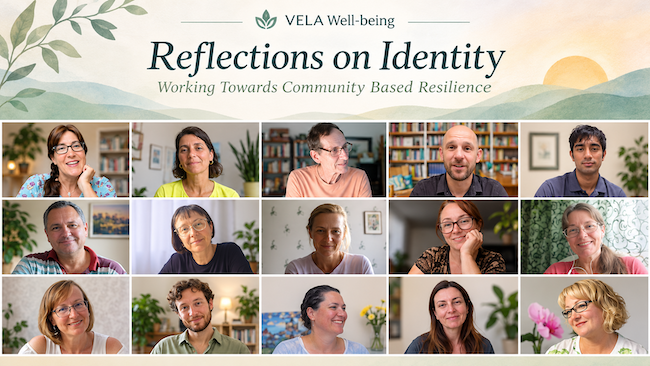
During VELA Well-being’s professional training series, “Reflections on Identity: Working Towards Community Based Resilience,” Dr. Joe Mageary explored the relationship between storytelling, identity, and human connection.
One of the central ideas of the training was that storytelling is a universal human experience. Through stories, we pass along our cultures, religions, beliefs, and values. We connect with previous generations, make sense of our experiences, and imagine our futures.
For educators, psychologists, counselors, and other helping professionals, understanding this relationship can provide valuable insights into supporting individuals and communities experiencing adversity.
Our Identities Are Shaped Through Stories and Relationships
Identity is not simply a collection of personal characteristics. It develops through our experiences, relationships, social environments, and the meanings we assign to what happens in our lives.
We may describe ourselves as parents, educators, friends, leaders, caregivers, or community members. We may also identify as creative, compassionate, courageous, or responsible.
These descriptions become part of how we understand ourselves.
However, our identities do not develop in isolation.
From childhood, we learn about ourselves through interactions with others. The stories our families tell, the expectations of our communities, and the experiences we share contribute to our understanding of who we are.
As emphasized during the VELA training, the stories we tell and the relationships we enact contribute to making us who we are.
For example, a child who frequently hears stories about their curiosity and determination may begin to recognize these qualities as part of their identity.
Similarly, an educator who receives appreciation for helping students navigate difficult situations may strengthen their identity as a caring and capable professional.
Stories do more than describe our experiences. They influence how we interpret those experiences and understand ourselves.
We Are More Than One Story
Each person carries multiple identities.
We may be professionals, parents, partners, friends, neighbors, artists, learners, or community leaders. Different situations bring different aspects of our identities forward.
During the training, Dr. Mageary introduced Carl Jung’s concept of personae, referring to the different social roles or presentations of ourselves that we adopt in various contexts.
Two important tasks in adult identity development were highlighted:
- Recognizing our different personae and understanding when we express them.
- Remembering that these personae do not represent our entire selves.
This distinction becomes especially important during periods of prolonged stress, trauma, or uncertainty.
For example, an educator living through wartime may become primarily focused on protecting students, helping families, and maintaining educational continuity.
While these responsibilities are meaningful, the educator may gradually feel disconnected from other parts of their identity, such as being an artist, musician, traveler, or someone who enjoys spending time with friends.
These aspects of identity may become less visible during adversity, but that does not necessarily mean they have disappeared.
When Adversity Changes Our Personal Stories
War, displacement, loss, and prolonged uncertainty can influence not only what we do but also how we understand who we are.
A person who once described themselves as adventurous and optimistic may begin to think:
“I am someone who is constantly afraid.”
A caregiver who has spent years supporting others may begin to believe:
“My only purpose is to take care of everyone else.”
An educator facing overwhelming challenges may start telling themselves:
“I am no longer the teacher I used to be.”
These thoughts may reflect genuine distress and difficult experiences. They deserve understanding rather than judgment.
However, they may not capture the entirety of a person’s identity.
During the VELA training, participants were invited to consider whether there were aspects of their preferred selves from which they had become disconnected during wartime. They were also encouraged to recognize which valued qualities they had managed to preserve despite ongoing challenges.
The goal is not to deny suffering or force positive thinking. It is to recognize that hardship may shape our current story without defining every aspect of who we are.
From Disconnection to Reconnection
Dr. Mageary also explored how war and prolonged adversity can create disconnection between individuals, within communities, and between different aspects of ourselves.
When people no longer recognize themselves in the roles or qualities that once brought meaning to their lives, they may experience frustration, sadness, or self-judgment.
Self-judgment can contribute to withdrawal and isolation, while isolation may intensify emotional distress.
During the training, participants were reminded that distress can be isolating, and isolation itself can be distressing.
Yet processing difficult experiences can also open opportunities for reconnection.
Feeling connected to others, to meaning and purpose, and to nature can serve as an important protective factor.
The training introduced the concept of “The Archaeology of Hope” (Monk et al., 1997), inviting participants to explore how people might reconnect with valued aspects of their identities from which they have become separated.
Just as an archaeologist uncovers what has been hidden, we can explore our experiences to rediscover qualities, relationships, hopes, and values that may have been overshadowed by adversity.
What This Means for Helping Professionals
Educators, psychologists, counselors, and other helping professionals can use storytelling to support identity exploration, reflection, and human connection.
Rather than focusing exclusively on problems or difficult experiences, professionals can invite individuals to explore different aspects of their personal stories.
Helpful questions may include:
- What stories do you tell yourself about who you are?
- Which experiences have shaped your understanding of yourself?
- What personal qualities have helped you navigate difficult situations?
- Are there parts of your identity that have received less attention recently?
- What relationships or activities help you feel connected to yourself?
These questions create opportunities to recognize the complexity of personal identity.
Importantly, individuals should be free to choose whether and how much they share. Storytelling should support understanding rather than pressure anyone to revisit painful experiences.
From Personal Stories to Community Resilience
Our stories also shape the communities to which we belong.
Families, schools, workplaces, and communities develop shared narratives about their histories, values, experiences, and hopes.
During prolonged adversity, these narratives may become dominated by loss, uncertainty, or exhaustion.
Yet communities also carry stories of cooperation, kindness, creativity, solidarity, and perseverance.
When individuals share and listen to these stories, they may discover common values, strengthen relationships, and recognize opportunities for collective action.
Supporting community resilience does not mean expecting everyone to remain strong at all times. It means creating opportunities for connection, belonging, mutual support, and meaningful participation.
Final Reflection
We cannot always choose the experiences that enter our lives.
However, we can sometimes become more aware of how we interpret those experiences, which stories we repeatedly tell, and which aspects of our identities receive our attention.
Our stories may include suffering and uncertainty. They may also include courage, compassion, love, connection, and hope.
Each of these experiences can be part of who we are.
No single experience, role, or difficult chapter can fully describe a human being.
Acknowledgment
This educational article was developed by VELA Well-being based on the presentation by Dr. Joe Mageary during the professional training series “Reflections on Identity: Working Towards Community Based Resilience,” conducted in summer 2026 for Ukrainian educators, psychologists, and other helping professionals.
The article adapts concepts introduced in the training for a broader international audience.