
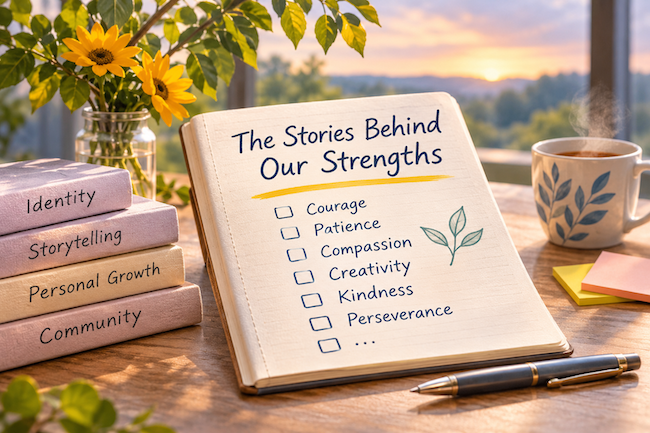

An Activity for Exploring Personal Qualities, Identity, and Human Connection
For: Educators, psychologists, counselors, peer-support facilitators, youth groups, and other helping professionals
Format: Individual reflection, pairs, classroom, or group activity
Suggested Duration: 15–25 minutes (adaptable)
Materials: Paper and pen, or a digital device for recording reflections
About This Activity
We often recognize qualities such as courage, patience, kindness, and resilience in other people. Yet we may find it difficult to recognize these same qualities in ourselves.
Stories can help us understand personal qualities through real human experiences.
During VELA Well-being’s professional training series, “Reflections on Identity: Working Towards Community Based Resilience,” Dr. Joe Mageary introduced a closing activity inviting participants to identify qualities they wished to strengthen and explore them through stories about others.
The activity connects personal reflection with storytelling and human relationships.
It can be used with adults, educators, helping professionals, and students, with appropriate adaptations for age and setting.
Purpose
This activity encourages participants to:
- Reflect on personal values and preferred qualities.
- Recognize how qualities are expressed through actions.
- Explore positive aspects of identity.
- Strengthen connections through storytelling and listening.
- Consider how valued qualities might be expressed in everyday life.
Step-by-Step Instructions
Step 1: Identify Qualities You Value
Invite participants to sit comfortably and take a moment to reflect.
Ask:
“What traits or qualities would you like to have more of in your life?”
Encourage participants to write down as many qualities as they wish.
They can use a single word or short phrase for each quality.
Examples include:
- Courage
- Patience
- Compassion
- Creativity
- Kindness
- Confidence
- Perseverance
- Curiosity
- Generosity
- Inner peace
There are no right or wrong answers.
Participants should choose qualities that feel personally meaningful rather than qualities they believe others expect them to have.
Step 2: Choose One Quality
Invite participants to review their lists and choose one quality they would like to explore.
They may select a quality they already recognize in themselves or one they hope to express more often.
For example:
“I choose courage because I want to feel more confident when facing unfamiliar situations.”
Or:
“I choose compassion because I want to respond to myself and others with greater understanding.”
Participants do not need to explain their choices unless they wish to.
Step 3: Discover a True Story
Ask participants to invite another person to share a true story about someone whose actions demonstrated their selected quality.
The storyteller might describe a family member, friend, colleague, community member, historical figure, or another person.
For example, someone who selected courage might hear a story about a neighbor who helped others during an emergency.
Someone who selected kindness might hear about a teacher who consistently supported a struggling student.
The important element is that the story describes a real person’s actions that reflect the chosen quality.
For classroom activities, teachers can invite students to share stories in pairs or small groups.
Participants should be reminded not to disclose private information about others without permission.
Step 4: Reflect on the Story
After listening, invite participants to consider:
- What actions demonstrated the selected quality?
- What made this person’s behavior meaningful?
- Did the story change or deepen your understanding of the quality?
- Have you ever demonstrated this quality in your own life?
- How might you express this quality in your everyday activities or relationships?
Participants can reflect privately, write a few sentences, or share their thoughts with others.
Step 5: Share and Connect (Optional)
Invite volunteers to share their experiences with the group.
They might describe:
- The quality they selected.
- A brief summary of the story they heard.
- What they learned about that quality.
- How the experience influenced their understanding of themselves.
Emphasize that participation is voluntary.
In an ongoing group or classroom, the facilitator can invite two or three participants to share their reflections during a subsequent meeting, as suggested in Dr. Mageary’s original activity.
Facilitator Recommendations
Create a supportive environment. Remind participants that everyone has different experiences, values, and personal strengths.
Avoid comparisons. The purpose is not to determine who demonstrates a quality better than others. It is to explore how qualities can appear in different lives and circumstances.
Respect personal boundaries. Some stories may involve difficult experiences. Participants should never feel pressured to disclose personal or traumatic information.
Encourage curiosity. Invite participants to listen with interest rather than immediately evaluating or interpreting the storyteller’s experiences.
Welcome different perspectives. A single quality may be expressed differently across cultures, generations, and personal circumstances.
Why This Activity Matters
Personal qualities are more than abstract words.
We recognize them through experiences, choices, relationships, and actions.
When participants hear stories illustrating courage, kindness, patience, or perseverance, these qualities can become more meaningful and easier to recognize.
The activity also offers an opportunity to reflect on aspects of personal identity that may have received less attention during stressful or demanding periods.
For helping professionals, it provides a simple way to encourage reflection, listening, and positive social connection without requiring participants to disclose painful personal experiences.
Closing Reflection
Invite participants to consider:
“What does this story help me recognize about the person I am or the person I would like to become?”
Participants may choose to remember this question during the following week as they notice opportunities to express their selected quality.
Sometimes, hearing another person’s story helps us recognize something meaningful within our own.
Activity Credit and Acknowledgment
Activity introduced by Dr. Joe Mageary during VELA Well-being’s professional training series “Reflections on Identity: Working Towards Community Based Resilience,” summer 2026.
The original closing activity invited participants to identify valued personal qualities, select one, and ask another person to share a true story demonstrating that quality.
This website version was adapted and expanded by VELA Well-being to provide additional facilitation guidance, reflection questions, and practical applications for educators, psychologists, and other helping professionals.