
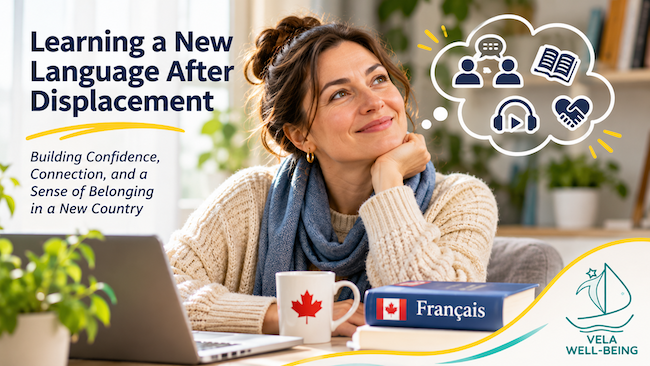

Learning a New Language in a New Country
DISPLACEMENT | CULTURAL ADAPTATION | ADULT LEARNING
Professional Question
How can helping professionals support displaced adults who struggle to learn a new language, particularly when fear of mistakes and limited opportunities for communication interfere with progress?
Professional Response
Participants emphasized the importance of combining structured learning with real-life communication.
1. Normalize the learning process.
Learning a new language as an adult can require sustained effort, particularly during displacement and adaptation to an unfamiliar environment.
Comparing one’s progress with children’s language development may create unrealistic expectations.
2. Practice communication, not just memorization.
Learning vocabulary and grammar is useful, but opportunities to use the language in everyday conversations are essential.
Participants suggested joining community groups, visiting libraries, participating in hobby groups, and finding environments where interaction happens naturally.
3. Create opportunities for practical language use.
Volunteering or working in an appropriate setting may provide opportunities to practice speaking, listening, and responding in everyday situations.
Activities should reflect the individual’s interests, circumstances, and readiness.
4. Allow mistakes.
Participants emphasized that effective communication does not require perfect pronunciation or grammar.
A learner can communicate successfully while still making mistakes.
The goal is to be understood and gradually become more comfortable speaking.
5. Use technology for additional practice.
AI conversation tools can provide opportunities to practice speaking before interacting with others.
For example, learners can simulate conversations at a store, medical office, or workplace and ask for explanations of unfamiliar expressions.
6. Integrate language learning into daily routines.
Suggestions from the meeting included describing daily activities aloud in a new language, learning several new words each day, reading short texts, and watching familiar content in a new language.
Additional Professional Suggestions
Create a language-confidence ladder. Begin with manageable interactions and gradually increase the difficulty.
Example: Five Steps Toward Confident Communication
- Practice greeting someone aloud at home.
- Ask a simple question in a shop.
- Have a short conversation with a neighbor.
- Join a group activity conducted in a new language.
- Participate in a longer conversation about a familiar topic.
Pair language learning with meaningful activities. Learning vocabulary through cooking, gardening, art, or volunteering may make it easier to remember and use.
Explore emotional barriers. Some displaced individuals may experience grief, isolation, social anxiety, or cognitive fatigue that affects learning. Professionals should explore these possibilities without assuming that every language difficulty is trauma-related.
Celebrate practical progress. Encourage learners to recognize successes such as making an appointment, asking for directions, or holding a short conversation.
Connect people with community resources. Local integration programs, adult education centers, libraries, and conversation partners may offer accessible learning opportunities.
Key Takeaway
Language learning is not only about acquiring words and grammar. It is also about developing confidence, building relationships, and finding a sense of belonging in a new environment.