
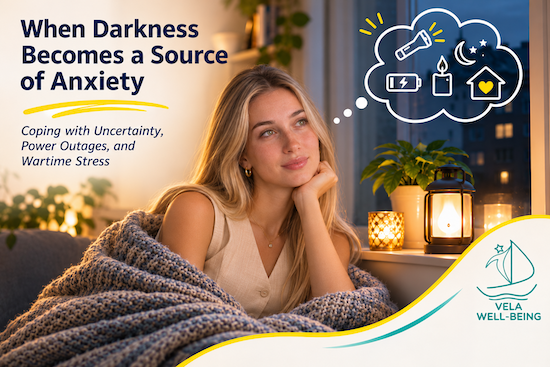

PROLONGED TRAUMA | WARTIME STRESS | ANXIETY | COPING
How to find ways to feel more secure without relying entirely on nightlight during electricity outages.
Professional Question
How can helping professionals support individuals whose anxiety about darkness is intensified by prolonged power outages, uncertainty, and possible exposure to wartime threats?
Professional Response
Participants recognized that fear of darkness under wartime conditions may involve more than discomfort with the absence of light.
Darkness can become associated with danger, uncertainty, air raids, and a reduced sense of control.
The discussion explored the following approaches.
1. Identify what the darkness represents.
A participant suggested exploring whether the woman fears darkness itself or the events she associates with nighttime.
Understanding this distinction may help determine what kind of support is needed.
2. Explore the relationship between thoughts and anxiety.
Participants suggested examining where attention goes during periods of darkness.
Does the person imagine potential threats? Does she repeatedly worry about the nightlight failing?
Recognizing these thought patterns may create opportunities for developing additional coping strategies.
3. Practice imagery when appropriate.
One suggestion was to imagine light, warmth, or a comforting environment.
Such imagery may help some people shift attention toward reassuring experiences.
However, imagery does not work for everyone and should not be presented as a replacement for actual safety measures.
4. Provide alternative sources of comfort.
The group discussed practical options such as glow-in-the-dark stars, rechargeable lamps, LED lighting, and other low-energy light sources.
These alternatives may reduce dependence on a single nightlight.
5. Recognize the effects of prolonged stress.
Participants acknowledged that repeated exposure to danger and uncertainty can affect an individual’s capacity to cope.
A persistent increase in anxiety may indicate a need for additional psychological support.
6. Consider available choices and resources.
The discussion also addressed the difficult decisions people face when determining whether to remain in challenging circumstances or seek a different environment.
Participants emphasized that these decisions are deeply personal and may benefit from professional support.
Additional Professional Suggestions
Create a practical nighttime safety plan. Identify accessible lighting, a charged phone, necessary supplies, and a safe location to use during official alerts. Psychological comfort should complement—not replace—real safety precautions.
Develop several sources of reassurance. Rather than removing the nightlight, introduce additional coping resources so the person does not feel dependent on only one object.
Use grounding based on present reality. For example, when physically safe, notice the contact of the feet with the floor, the support of the chair, or familiar sounds in the room.
Create a calming evening routine. Gentle stretching, familiar music, supportive conversations, or quiet activities may help some people manage anticipatory anxiety.
Distinguish realistic danger from anticipatory worry. When there is an actual security threat, protective action takes priority. When there is no immediate threat, psychological strategies may help manage distress about what might happen.
Seek additional support when necessary. If anxiety significantly interferes with sleep, daily functioning, or the person’s ability to feel safe, a trauma-informed mental health professional can help assess the situation and develop an individualized plan.
Key Takeaway
When darkness becomes associated with danger, effective coping involves both practical safety measures and emotional support. The goal is not to convince someone that nothing bad can happen, but to strengthen their ability to respond, find comfort, and maintain a sense of agency under difficult circumstances.