

Teachers Support a Child Experiencing Intense Fear or Panic-Like Reaction
CHILDHOOD ANXIETY | SCHOOL SUPPORT | PHOBIAS
How can teachers support a child experiencing intense fear or panic-like reactions without reinforcing the fear
Case Description
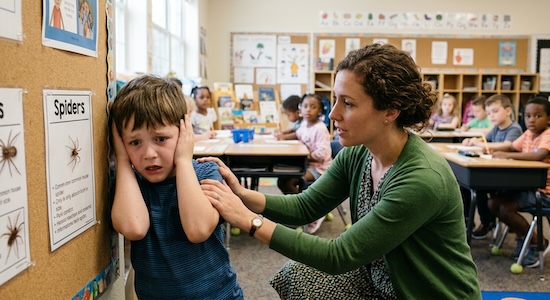
An elementary school teacher is concerned about a boy in her classroom who experiences an intense fear of spiders.
On several occasions, the child has reacted with significant panic-like distress after encountering spiders.
Professional Question
How can teachers support a child experiencing intense fear or panic-like reactions without reinforcing the fear, increasing distress, or attempting interventions beyond their professional role?
Professional Response
The VELA participants highlighted several important considerations.
1. Create a physically and emotionally safe environment.
The teacher’s first responsibility is to provide a supportive learning environment and minimize avoidable triggers where practical.
Participants noted that spiders might appear naturally in school buildings or emergency shelters. Therefore, avoiding every possible encounter may not be realistic.
2. Understand the context.
Before choosing an intervention, educators should determine how the child encounters spiders.
Are spiders appearing naturally? Are they present in educational materials? Are other children deliberately frightening the student?
If peers are intentionally using the child’s fear against him, the situation also requires an appropriate response to bullying.
3. Respond calmly to acute distress.
The teacher can acknowledge the child’s feelings without exaggerating or dismissing the situation.
For example:
“I can see that you are frightened. I’m here with you. We can move to another place.”
The child should not be forced to look at the spider or confront the feared object during an episode of severe distress.
4. Use simple grounding strategies.
Participants suggested helping the child return attention to the immediate environment through grounding techniques.
These may include noticing the floor beneath the feet, identifying familiar objects, or gently slowing breathing if the child finds that helpful.
5. Involve a qualified mental health professional.
Participants discussed using play, drawing, stories, and other psychological techniques to help children process fears.
These interventions should be guided by an appropriately trained professional rather than improvised by a teacher during classroom activities.
Additional Professional Suggestions
Develop an individualized classroom response plan. Coordinate with the child’s caregivers, school psychologist, and other relevant professionals. Identify who will respond, where the child can go, and what strategies the child prefers.
Avoid minimizing the fear. Comments such as “It’s just a little spider” may be intended as reassurance but can make a frightened child feel misunderstood.
Offer choices. Ask whether the child would prefer to sit near the teacher, step away, or use a previously practiced calming technique.
Teach coping skills during calm moments. Grounding and self-regulation strategies are generally easier to learn when the child is not already overwhelmed.
Consider evidence-based treatment. If the fear is persistent, severe, or interferes with school participation, caregivers can seek evaluation by a child mental health professional experienced in anxiety disorders. Cognitive behavioral therapy, often including carefully planned gradual exposure, is an established treatment for specific phobias. Exposure should not be forced or improvised by school staff.
Do not dismiss the need for assessment. A psychiatric consultation is not automatically necessary for every phobia, but repeated severe reactions deserve appropriate evaluation. Referral decisions should consider severity, impairment, other symptoms, and access to qualified care.
Key Takeaway
The teacher does not need to eliminate the child’s fear. The immediate goal is to help the child feel supported and safe while ensuring that persistent or severe anxiety receives appropriate professional attention.