
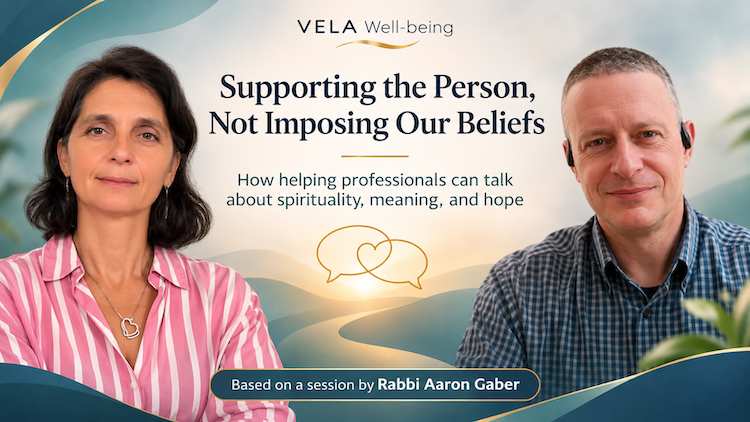

Practical guidance for educators, counselors, psychologists, social workers, and everyone in helping professions.
Based on a professional learning session facilitated by Rabbi Aaron Gaber for VELA Well-being.
When someone is experiencing grief, uncertainty, trauma, or emotional distress, questions about meaning, faith, purpose, and hope may naturally arise. For helping professionals, these conversations can be meaningful but also challenging, especially when the person seeking support holds different religious or spiritual beliefs—or has none at all.
How can we offer support without imposing our own beliefs? How can we explore spirituality while respecting each person’s values, experiences, and understanding of the world?
During a recent VELA Well-being professional learning session, Rabbi Aaron Gaber shared practical approaches to supporting individuals from diverse religious, spiritual, and nonreligious backgrounds.
His central message was simple:
“Begin with the person, not their religion, and not our religion.” — Rabbi Aaron Gaber
1. Begin With the Person, Not Their Beliefs
When someone comes to us for support, we may naturally approach the conversation through our own experiences, values, or spiritual beliefs.
However, the person sitting across from us may understand life very differently.
Rather than beginning with questions about religion or faith, Gaber encourages helping professionals to begin with the person’s experience.
Consider asking:
- How are you doing, really?
- What has been the hardest part of your experience?
- What helps you keep going when things become difficult?
- What gives you strength?
- Who or what can you rely on?
These questions invite people to share what matters to them without making assumptions about their beliefs.
A person of faith may naturally speak about God, prayer, or their religious community. Someone else may identify family, friendship, personal values, nature, or a sense of responsibility as their sources of strength.
Our responsibility is not to determine what should give someone strength, but to help them recognize what already does.
2. Use Language That Creates Connection
One of the important ideas Gaber explored was the value of universal language.
Words that carry deep spiritual significance for one person may have different meanings for another. Rather than avoiding spiritual conversations, helping professionals can use inclusive language that allows individuals to describe their experiences in their own words.
For example:
| Religious or spiritual language | More universal language |
|---|---|
| Faith and prayer | Trust and sources of strength |
| God’s plan | Purpose and direction |
| Blessings | Gratitude and appreciation |
| Spiritual strength | Inner strength and resilience |
| Religious community | Connection and belonging |
| Forgiveness | Reconciliation and healing |
| Hope in God | Hope for the future |
These concepts are not necessarily identical, but they can provide common ground for meaningful conversations.
For example, rather than asking, “How is your faith helping you through this?” consider asking:
“What gives you strength when things are difficult?”
This allows the person to introduce spirituality if it is meaningful to them, without feeling pressured to respond within a particular religious framework.
3. Replace Assumptions With Curiosity
Spiritual support does not require sharing the same worldview.
It requires curiosity, humility, and a willingness to understand how another person makes sense of their experiences.
Questions such as “What principles guide your decisions?” or “What gives your life meaning?” can open conversations about personal values, identity, spirituality, and purpose.
For someone experiencing grief, guilt, or a conflict with their personal values, these conversations may be especially important.
A person might say, “I did something that I cannot forgive myself for.”
Rather than immediately offering reassurance, judgment, or a religious interpretation, a helping professional might respond:
“It sounds like you are carrying something very difficult. Would you be willing to tell me what happened?”
Additional questions might include:
- What values do you feel were challenged?
- How has this experience changed the way you see yourself?
- What would healing or making things right look like for you?
These questions create an opportunity for reflection without requiring a particular religious or spiritual interpretation.
When experiences involve significant trauma, moral injury, or persistent psychological distress, such conversations may also indicate a need for additional support from appropriately qualified professionals.
4. Five Essential Skills for Supportive Conversations
Gaber emphasized five practices that can help professionals create a respectful environment for discussing spirituality and personal meaning.
Active listening. Listen carefully to the person’s words, emotions, and concerns. Allow their story to guide the conversation.
Cultural and religious humility. Ask rather than assume. Recognize that people may understand spirituality, faith, and purpose in different ways.
Nonjudgmental presence. Create an environment where individuals feel comfortable sharing difficult experiences, questions, or doubts.
Support without religious pressure. Share personal beliefs or spiritual perspectives only when appropriate and welcomed, keeping the focus on the person seeking help.
Confidentiality and trust. Respect privacy, explain any professional limits to confidentiality, and develop relationships in which individuals feel safe to speak openly.
Together, these practices help people feel heard, respected, and supported.
5. Five Questions Every Helping Professional Can Keep Ready
Gaber offered five accessible questions that can be used in a wide range of supportive conversations:
- What is weighing on you right now?
- What gives your life meaning and purpose?
- Where do you find strength when things become difficult?
- Who can you rely on?
- How can I best support you right now?
These questions do not require a shared religious belief. They invite people to identify their own resources, relationships, and sources of meaning.
They can be useful in individual conversations, educational settings, peer-support groups, and other professional relationships where appropriate.
6. Supporting Others Also Requires Caring for Ourselves
Toward the end of the session, Gaber addressed another important question: How can those who regularly support people experiencing suffering avoid burnout?
He reminded participants that sustained helping work is a marathon, not a sprint.
Sometimes we need to slow down, walk instead of run, or stop briefly before continuing.
He encouraged helping professionals to identify what replenishes their own emotional and physical resources. This may include exercise, meditation, time with loved ones, rest, or other personally meaningful self-care practices.
Supporting others does not mean remaining available at full capacity every moment.
Recognizing our limitations and caring for our own well-being helps us continue offering meaningful support over time.
Final Reflection: Help People Find Their Own Strength
One of the most meaningful lessons from Gaber’s presentation is that supporting someone’s spiritual well-being does not mean guiding them toward our personal beliefs.
Instead, it means creating space for people to explore their own experiences, values, questions, and sources of hope.
For some, this exploration may lead to conversations about God or faith. For others, it may involve family, relationships, personal responsibility, gratitude, community, or a vision for the future.
The role of a helping professional is to listen, remain curious, respect individual differences, and support each person’s search for meaning.
We do not need to share someone’s beliefs to help them discover their own strength.
Acknowledgment
VELA Well-being sincerely thanks Rabbi Aaron Gaber, a rabbi and U.S. Army military chaplain, for generously sharing his professional experience, practical questions, and insights during our November 17, 2026, learning session with Ukrainian helping professionals.
This article adapts key ideas from his presentation for a broader audience of educators, counselors, psychologists, social workers, and others who support individuals experiencing adversity.
At VELA Well-being, we believe that those who support others also deserve support.
VELA Well-being — Supporting Those Who Support Others.