
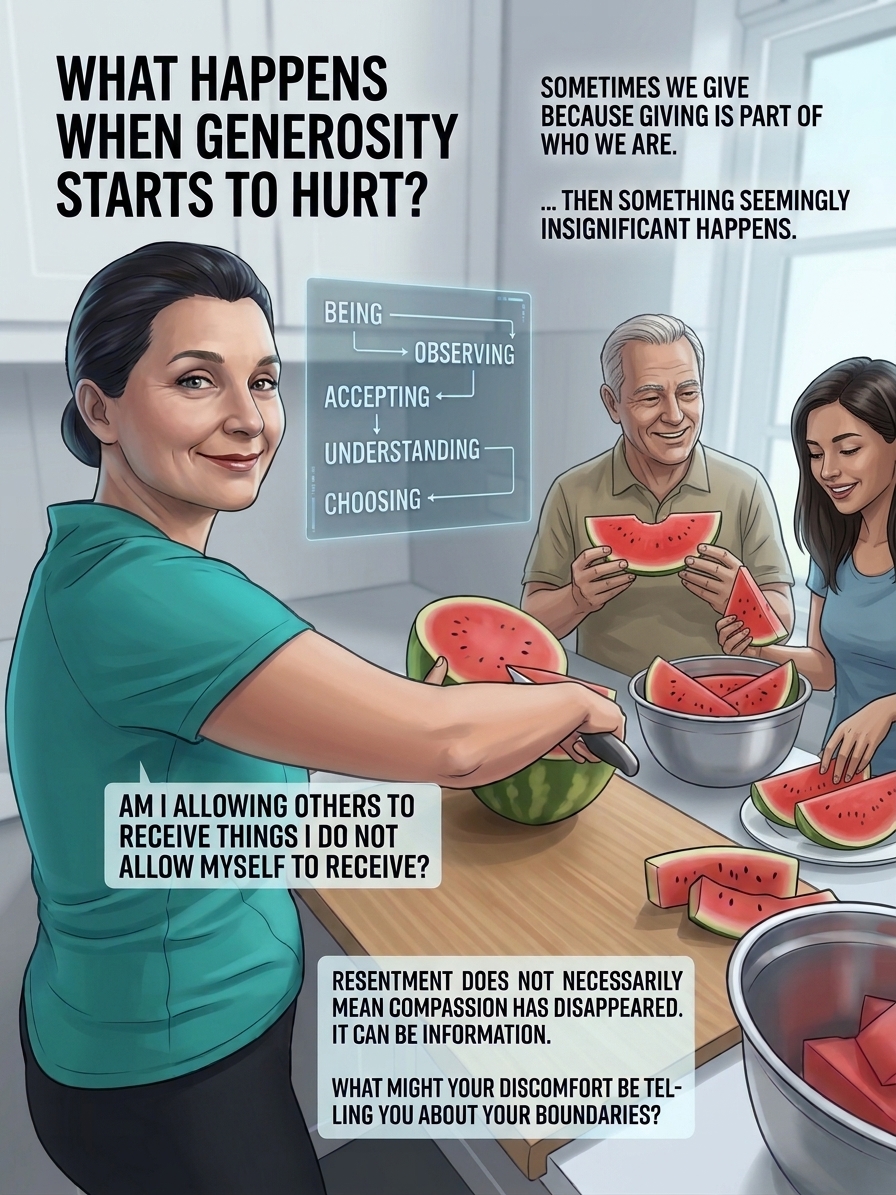

What happens when generosity starts to hurt?
Sometimes we give because giving is part of who we are.
We offer our time, attention, resources, knowledge, emotional energy, and practical support. We may genuinely enjoy helping and believe deeply in compassion, service, and generosity.
Then something seemingly insignificant happens.
Perhaps we notice that someone comfortably accepts the best of what is available while we automatically take what is left.
Nothing dramatic happens.
No major conflict.
No obvious wrongdoing.
And yet, something inside us reacts.
A small feeling of irritation. Hurt. Resentment. Unfairness.
And then another thought may appear:
“Why am I feeling this way? I chose to give.”
For helping professionals and caregivers, this can be an important moment of awareness.
The discomfort may not really be about what just happened.
Maybe it is about reciprocity.
Maybe it is about boundaries.
Maybe giving has slowly shifted from a conscious choice into an expectation.
Or perhaps there is another question worth asking:
Am I allowing others to receive things I do not allow myself to receive?
Narrative Awareness® invites us to resist the urge to immediately create a verdict:
They are selfish.
I am too generous.
I shouldn’t feel this way.
Instead, we can move through:
Being → Observing → Accepting → Understanding → Choosing
I notice resentment.
Can I observe it without immediately judging myself or the other person?
Can I accept that this feeling is here?
What might it be telling me?
Is a boundary being crossed?
Am I giving something I no longer freely want to give?
Am I expecting reciprocity that has never been discussed?
Am I offering others a level of care, comfort, or permission that I rarely offer myself?
And then comes Choosing.
Perhaps I continue giving, but more consciously.
Perhaps I establish a boundary.
Perhaps I communicate a need.
Perhaps I change an arrangement.
Or perhaps I simply begin giving myself permission to receive the same care I so readily offer others.
For those of us who care for others, resentment does not necessarily mean that compassion has disappeared.
Sometimes resentment is information.
It can invite us to notice the difference between giving from choice and giving from obligation, and between serving others and consistently placing ourselves last.
We can believe deeply in generosity and still have boundaries.
We can live with gratitude and abundance and still recognize when something does not feel right.
And we can care deeply for others without always giving them the best while quietly accepting less for ourselves.
What might your discomfort be trying to tell you about your boundaries, expectations, and relationship with yourself?
Narrative Awareness® begins not with judging the story, but with observing it.