
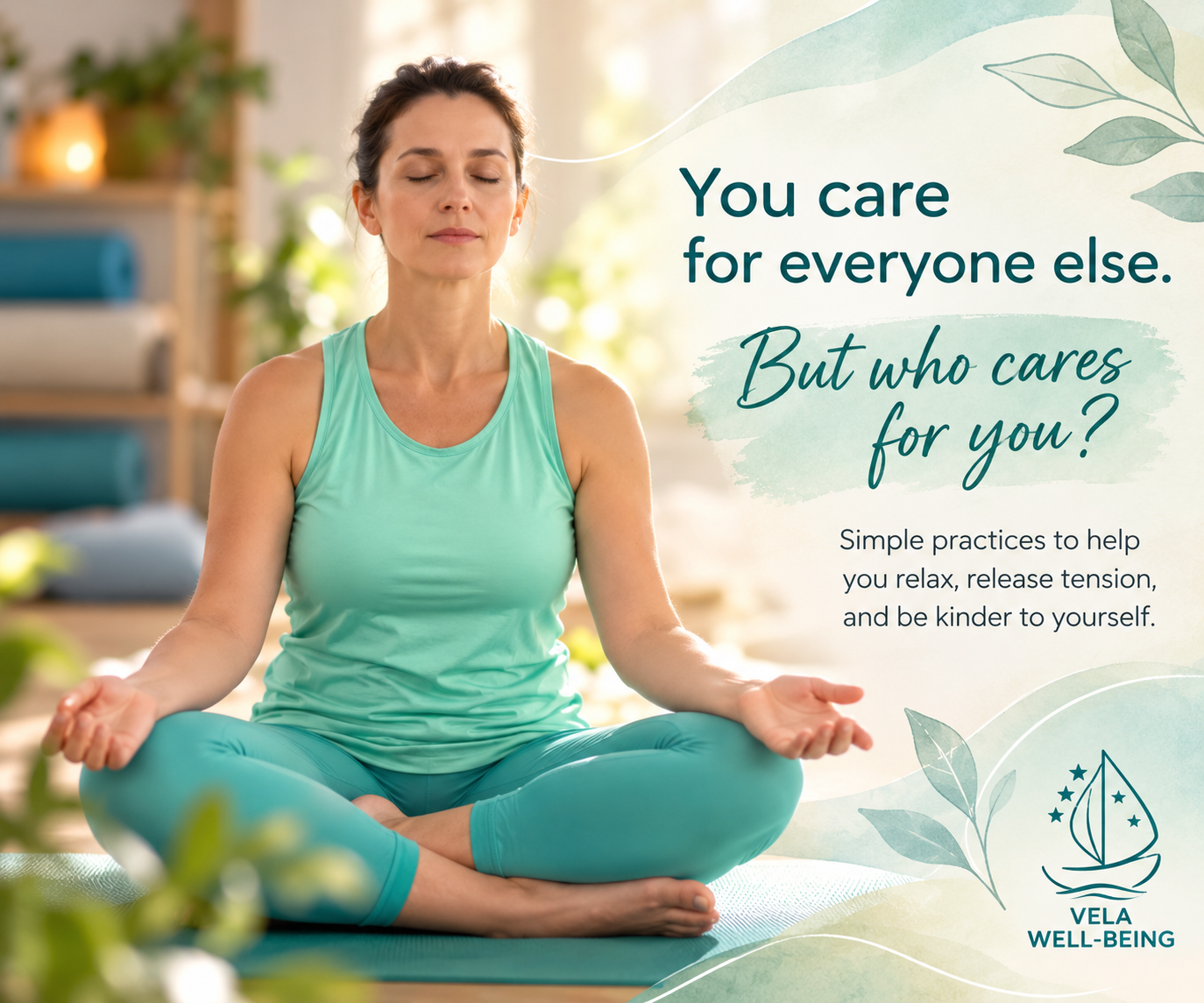

Caring for Yourself Through Gentle Movement, Touch, and Self-Forgiveness
Practical coping strategies for helping professionals, caregivers, and anyone experiencing stress
When was the last time you made yourself truly comfortable?
Not simply sitting down after a long day, but intentionally adjusting your surroundings, relaxing your muscles, and giving your body the attention it deserves.
Helping professionals and caregivers spend much of their time responding to other people’s needs. They notice discomfort, offer reassurance, and create supportive environments for others. Yet their own physical discomfort can easily go unnoticed.
During a recent VELA Well-being Self-Care Hour, Dr. Natalya Rakevich, a certified yoga, mindfulness, and meditation instructor, guided participants through gentle yoga, self-massage, breathing, and reflection.
The session emphasized an important principle:
Self-care begins with recognizing what your body needs and allowing yourself to respond.
1. Give Yourself Permission to Be Comfortable
Before beginning the exercises, participants were invited to find a comfortable sitting position, using cushions and other supports if needed.
The invitation was simple: notice whether your position feels comfortable and make adjustments.
Practice: Creating Comfort
- Sit in a chair or on a cushion with your body supported.
- Adjust your position until you feel comfortable.
- Relax your shoulders and allow your hands to rest naturally.
- Take several easy, unforced breaths.
- Notice whether another small adjustment would make you more comfortable.
Consider this question:
How often do I make adjustments for other people’s comfort while overlooking my own?
Comfort does not have to be earned. Sometimes the smallest adjustments are meaningful acts of self-care.
2. Release Tension Through Gentle Self-Massage
Stress often accompanies muscle tension, particularly around the scalp, neck, and shoulders. During the session, participants explored how gentle touch and movement can bring attention to areas of discomfort.
Practice: A Three-Minute Head and Shoulder Reset
Step 1: Massage your scalp.
Place your fingertips gently against your scalp. Using small circular movements, massage from your temples and the sides of your head toward the crown.
Continue for approximately 30 seconds, using comfortable pressure.
Step 2: Relax your shoulders.
Place your right hand on your left shoulder. Gently squeeze and release the muscles across the top of the shoulder, avoiding pressure on the neck itself.
Repeat on the opposite side.
Step 3: Introduce gentle movement.
Slowly lift your shoulders toward your ears, then release them downward. Repeat five times.
Turn your head slightly to one side and return to the center. Repeat on the other side, staying within a comfortable range.
Step 4: Notice the difference.
Rest your hands on your lap. Observe whether your shoulders, jaw, or forehead feel different.
You do not need to force your muscles to relax. Simply offer them an opportunity.
Safety note: Avoid painful pressure, forceful neck movements, or pressing on the front or sides of the neck. Stop if you experience dizziness, pain, or other unusual symptoms. New or severe headaches, visual changes, or concerning blood pressure symptoms require medical evaluation rather than self-massage.
3. Explore the Connection Between Touch and Emotional Support
One of the session’s exercises involved placing a hand over the heart and imagining the heart smiling.
This gentle visualization offers an opportunity to experience self-directed warmth and compassion.
Practice: A Smile for Your Heart
- Place one hand comfortably over your chest.
- Notice the warmth of your palm.
- Imagine your heart surrounded by gentle sunlight.
- Allow a small smile to appear on your face, if it feels natural.
- Remain with this image for several comfortable breaths.
You might silently say:
“I can offer myself some of the kindness I offer others.”
Notice whatever arises without expecting a particular emotional response.
4. Practice Self-Forgiveness Without Pressure
Another meaningful part of the session focused on forgiveness, particularly forgiving ourselves.
Helping professionals often carry demanding expectations. They may feel responsible for outcomes they cannot fully control or criticize themselves for not accomplishing enough.
Self-forgiveness does not mean denying mistakes or abandoning responsibility. It means approaching our imperfections with understanding rather than endless self-punishment.
Practice: A Moment of Self-Forgiveness
Place your hand gently on your forehead or rest it comfortably over your chest.
Consider something for which you have been criticizing yourself.
Without forcing forgiveness, try these statements:
“I am learning.”
“I can acknowledge what happened without continually punishing myself.”
“I can take responsibility and still treat myself with compassion.”
“Even if I am not ready to forgive, I can allow myself time.”
During the session, an especially meaningful idea emerged: forgiving ourselves even for the things we are not yet able to forgive.
Self-forgiveness can be a process, not a demand.
5. Use Gentle Movement to Express and Release Tension
The session also included yoga postures designed to encourage movement, stretching, and rest.
Participants explored supported positions, including variations of Cobra Pose, Child’s Pose, and resting postures using cushions.
The purpose was not to achieve a perfect yoga position. It was to discover what movement or stillness felt supportive.
Practice: Supported Rest
- Place a cushion on a comfortable surface.
- Sit in a position that allows your back and shoulders to relax.
- Rest your hands on the cushion or your lap.
- If comfortable, lean forward slightly while keeping your neck supported.
- Remain for several natural breaths, then slowly return upright.
You may also choose to remain seated without leaning forward.
The important lesson is to listen to your body and adapt the practice to your needs.
You do not have to push yourself to benefit from self-care.
6. Choose Peace as an Intention
The session began with a reflection inspired by a prayer about the power of peace and concluded with an invitation to experience peace, joy, gratitude, and love.
For some people, these experiences are connected to spiritual beliefs. For others, they represent personal values or intentions.
Peace does not require the absence of difficulties. It may begin with choosing how we relate to ourselves while difficulties remain.
A Closing Reflection
Find a comfortable position.
Rest your hands naturally.
Take a few easy breaths and silently repeat:
“I welcome moments of peace.”
“I appreciate what my body does for me.”
“I can care for others while also caring for myself.”
“I am allowed to rest.”
Remain for a moment without trying to change anything.
Bringing Self-Care Into Everyday Life
You do not need an entire hour to begin caring for yourself.
A few minutes of gentle self-massage between appointments, adjusting your chair before a meeting, resting your shoulders after a difficult conversation, or replacing self-criticism with compassionate words can become meaningful parts of your daily routine.
For educators, psychologists, counselors, healthcare workers, and caregivers, these small practices offer opportunities to reconnect with their own needs.
The invitation from this VELA Well-being session is simple:
Notice your discomfort. Make room for comfort. Treat yourself with the care you so generously offer others.
Because those who support others deserve support, too.
This practice was adapted from a VELA Well-being Self-Care Hour facilitated by Dr. Natalya Rakevich, PhD, founder of VELA Well-being and creator of the Narrative Awareness® framework.
VELA Well-being is a U.S.-based nonprofit organization dedicated to supporting those who support others through professional collaboration, emotional support, and practical well-being resources.
These exercises are intended for general well-being and do not replace individualized medical or mental health care.